
Why Interior Basement Water Drainage Prevents Water Inside Your Home
Nobody wants water leaks and flooding in their home. So, it might surprise you that interior waterproofing is one of the most effective (as well as cost-effective) ways to protect your home from water.
Why? It starts with the reason why water breaks into the basement in the first place.
How Does Water Get Into My Basement?
To build a home, the builder digs a ditch. Then, they build the (often) concrete foundation.
At first, it looks like a bunch of concrete walls in a ditch. But, after they replace the exterior soil, it looks like what you'd expect a basement without a home built on top to look like.
What most people don't realize is that the area outside those concrete walls is still basically 'ditch' for water to come into. The replaced soil (called backfill) isn't compacted as tight as untouched soil, so water finds a lot more channels and less resistance to flow downhill.
As it flows downhill, the water accumulates outside the concrete walls. This creates what the industry calls hydrostatic pressure. This pressure exerted by water continues to press on the basement concrete walls.
Unfortunately, concrete is a porous material. Eventually, water fills all the voids and comes through. Maybe not right away, maybe not in the first year or two. But, eventually, it often does.
Hydrostatic Pressure and Fighting Smarter, Not Harder
Many people have tried to keep water outside of the home, and all of these solutions typically fail. Why?
One example: You can't stop hydrostatic pressure by installing a dampproof coating on your foundation. Eventually, the water breaks through.
Another example: It's extremely common for footing drains to clog, and, by replacing it, most people replace the same system that failed them.
You have to address the hydrostatic pressure to prevent the flooding from happening.
This is made possible by interior waterproofing.
The Insider Strategy: How Interior Drainage Works
To prevent flooding, you have to capture the water. A good interior drainage system has a few key features:
- Designed not to clog. It must sit on top of the footing, and not beside it, otherwise known as the 'mud zone'.
- Has a built-in 3/8-inch gap between the floor and the wall to drain wall leaks
- Does not rely heavily on filter fabric
- Has a big drain outlet to the sump
- Will not cause structural damage to the foundation
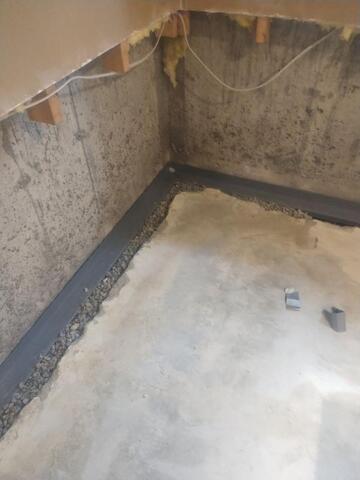
For example, we install WaterGuard, a sub-floor drainage system meets these requirements by capturing water at its most common entry point - the floor/wall cold joint.
This system can prevent water from getting into your living space, and addresses hydrostatic pressure by funneling the water away from the foundation, giving it someplace to go.
Rather than breaking into your home and your living space, you want to give the water the path of least resistance ... away from your basement, keeping it healthy and dry for years to come.
