
Why Is My Basement Wet?
Imagine one day, you walk into your basement, and you immediately realize the floor feels different — it's damp. Maybe that's the reality you're in right now while reading this.
If it's not due to a plumbing leak, there's many reasons why a basement can still get wet. A lot of it has to do with the way foundations are built.
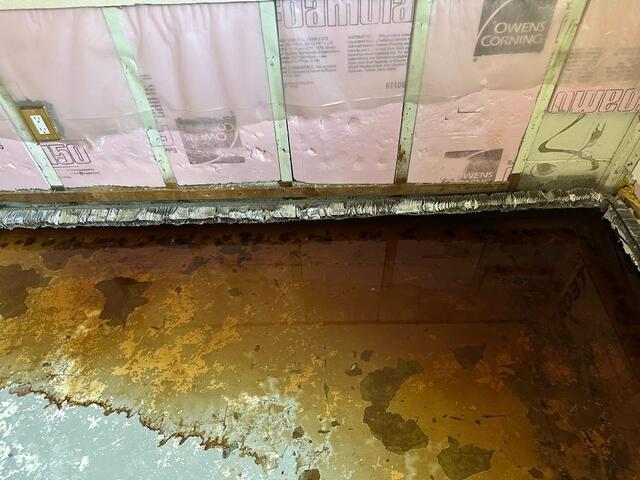
Reason 1: The "damp-proof" coating failed.
This is not uncommon. In fact, to an extent, it's expected. Many home builders will put an inexpensive black tar coating (called "damp-proofing") on the outside of the basement wall. However, this doesn't bridge wall cracks, doesn't stop water completely, and doesn't last forever. As this "damp-proof" coating disintegrates, the building water pressure outside of the basement wall finally seeps through the most vulnerable point of the foundation — at the floor-wall joist in your basement.
Reason 2: The footing drain failed.
Many home builders will also install a proper drain around the bottom of the foundation, which is called a footing drain, in order to prevent wet basements. However, footing drain failure is extremely common. Often times, you'll find several problems with footing drains, including:
- The drain leads to... nowhere.
- The place they lead to is crushed, clogged, or blocked.
- Over time, the drains clog as the water washing into them brings silt and mud with it.
- Putting stones around the drains give room for drainage and prevent clogging, but ultimately might have very little or no stone around them, since stone is expensive.
- The drains are not connected as a continuous loop or are installed too high.
As water fails to drain around the footing, hydrostatic pressure builds against the basement walls.
Thus, water seeps through the joint between the footing and the wall (as mentioned before), wall cracks and pipe penetrations, porous block walls, or even under the footing, although that's pretty rare.
Reason 3: Pump or power failure due to a faulty waterproofing system.
Let's say you addressed these issues by installing a waterproofing system and sump pump. Without the right drainage system, or the right sump pump... the problem might not go away. To start, not all sump pumps are equal — in fact, the most experienced generation of our times might recall that sump pumps haven't always been known to be reliable. Many older sump pumps would stop pumping during a power failure, or clog and stop working, or be unable to keep up with the high water volume in hard rain.
Modern sump pumps, however, have changed. For example, our TripleSafe© sump pump system includes three Zoellar pumps, the most reliable in our industry. It provides a battery-operated pump that will continue to pump even in a power outage, as well as two cast iron pumps to protect against pump failure or hard rain. This system can remove up to 6,400 gallons of water out of the basement per hour.
When paired with a full-perimeter drainage system designed and installed by a foundation and waterproofing expert, your basement will stay dry in rain or shine, all year long.
If you have a wet basement, don't worry — our modern basement waterproofing techniques can and will fix your water problem.
This is a great time to get your wet basement fixed for good. Our team even provides no-cost estimates — call today to set your free appointment.
